Free check · no account · about a minute

AEO tracking for your brand

When customers ask ChatGPT who to use, does it name you, or a competitor?

AEOTrack asks ChatGPT, Gemini, Claude, Perplexity and Grok the questions your buyers ask, every week, with live web search on. You see who each one named, read the stored answer, and get one specific thing to do this week. 14-day free trial.

We ask ChatGPT and Perplexity one question your buyers ask and show who they named: you, a competitor, or nobody. No account, no card.

Start free trial

Weekly tracking on five engines from $39/mo. 14 days free, no credit card.

Example · fictional demo brand “Acme Coffee Roasters”
ChatGPT Acme not named

Asked: best light roast coffee brands with web search on

Here are the roasters most often recommended for best light roast coffee brands:

  1. Bluebird Coffee — known for bright light roasts and a strong espresso lineup.
  2. Northwind Roasters — subscription-first roaster with a wide single-origin rotation.
  3. Juniper Roast Works — seasonal micro-lots, popular with pour-over enthusiasts.

Named instead: Bluebird Coffee, Northwind Roasters, Juniper Roast Works

One thing to do this weekTwo pages ChatGPT read for this answer recommend Bluebird and Northwind and never Acme. Ask both to review Acme.

An example from our demo workspace with a fictional brand, not a customer result.

Real AI answers, checked every week across ChatGPT, Gemini, Claude, Perplexity and Grok, each asked through its API in a fresh session with live web search on.

ChatGPTGoogle GeminiClaudePerplexityGrok

From your website to who AI names, in about 5 minutes

Three steps, no technical skills required: about 5 minutes to your first answers.

1

Add your site and questions

Enter your URL. We read your homepage, suggest the questions your buyers ask and the topics to track, and run the first check across ChatGPT, Gemini, Claude, Perplexity and Grok: one live answer per engine per question, with web search on. Google AI Mode joins as a sixth engine from Pro.

2

See who was named

For every question, per engine: you, a rival, or nobody, with the answer text and the pages the engine cited. A question no engine answers with any business is advice-only and left out of the score. AEO (questions) and GEO (topics) are scored separately.

3

Do one thing a week

Each week you get one specific thing to do, taken from the answers and the sites the engines read: usually getting onto a page that recommends your rivals. Then read what changed after the next weekly check.

What a first check usually finds

Composite example from first checks · a UK insurance broker · 5 questions on 5 engines, one answer each
Named in
0 of 25
answers
Where any brand was named
11 of 11
answers named a competitor
Cited as a source
4
answers, named in none
best motor trade insurance for small businesses3 rivals named, not you
top taxi insurance providers in the UKCited, not named
which platforms are used for commercial motor insuranceNobody named
One thing to do this weekThe roundup page all three engines cite lists your two rivals and not you. Get listed there.

A first check can come back with no answer naming you. Questions where no engine names any business are left out of the score.

AEOTrack dashboard of a demo workspace: this week's next three plan tasks, and the period summary of 13 questions asked across 5 engines and 60 answers read
The dashboard of a demo workspace: the week's ranked fixes on top, the period's counts below. Watch the 4-minute walkthrough.

Five things you learn about your business

Every one is read from real answers the engines gave to the questions your buyers ask.

Who AI names instead

For every question, which brands ChatGPT, Gemini, Claude, Perplexity and Grok recommend when it is not you — and how often, as share of voice against the competitors you name (10 on Starter and Pro, 25 on Agency).
Which sources decide your category

The roundups, review sites and forums the engines actually cite for your questions — the short list you need to be on, and whether your own pages are read but never named.

Weekly score with its ± range

An AI visibility score from 0 to 100, re-checked every week and shown with a range like 62 ±8, the range to expect between two checks, so you can tell a real move from the noise AI answers produce on their own.

One thing to do this week

A plan built from what the engines said and which sites they read: the listing to earn, the page that recommends your rivals, the question your own site never answers.

A message when it really changes

An email digest every week, and a Slack or Teams message when your score drops by more than the normal week-to-week wobble. Connections and alerts.

We don't sell llms.txt magic. We show which sites AI reads, and help you get onto them.

AI engines name the businesses that other sites recommend. So the plan points you at the review sites, roundups and forums each engine actually read for your questions. How we measure it.

Read the answer behind every number

Three things you can check for yourself behind every number on this page.

Real answers, not simulations

Five engines with live web search on, one answer per engine per question every week. The answer text sits behind every number, so you can read what the engine said. How the score is calculated.
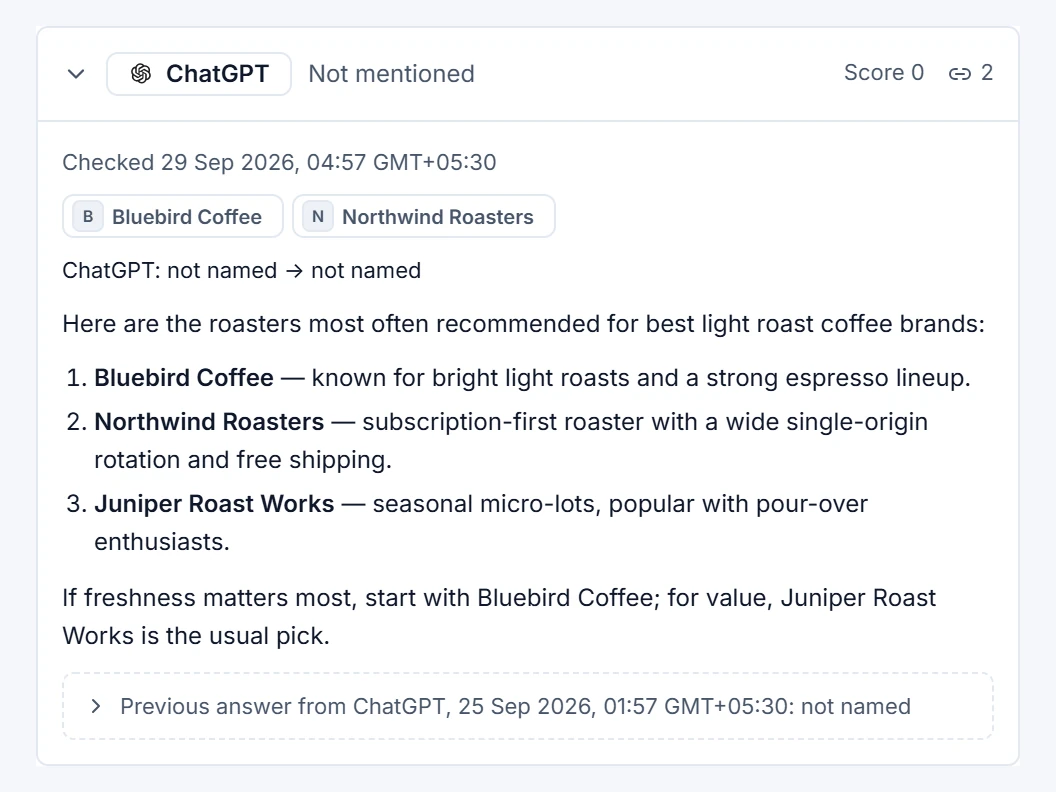
ChatGPT's stored answer for the demo question best light roast coffee brands: not named, the three roasters it recommended instead, and the previous week's answer

Who was named instead

For every question, the rival the engine named instead of you and the page that recommendation came from. The free audit shows it for ChatGPT and Perplexity; the tracker, for all five.
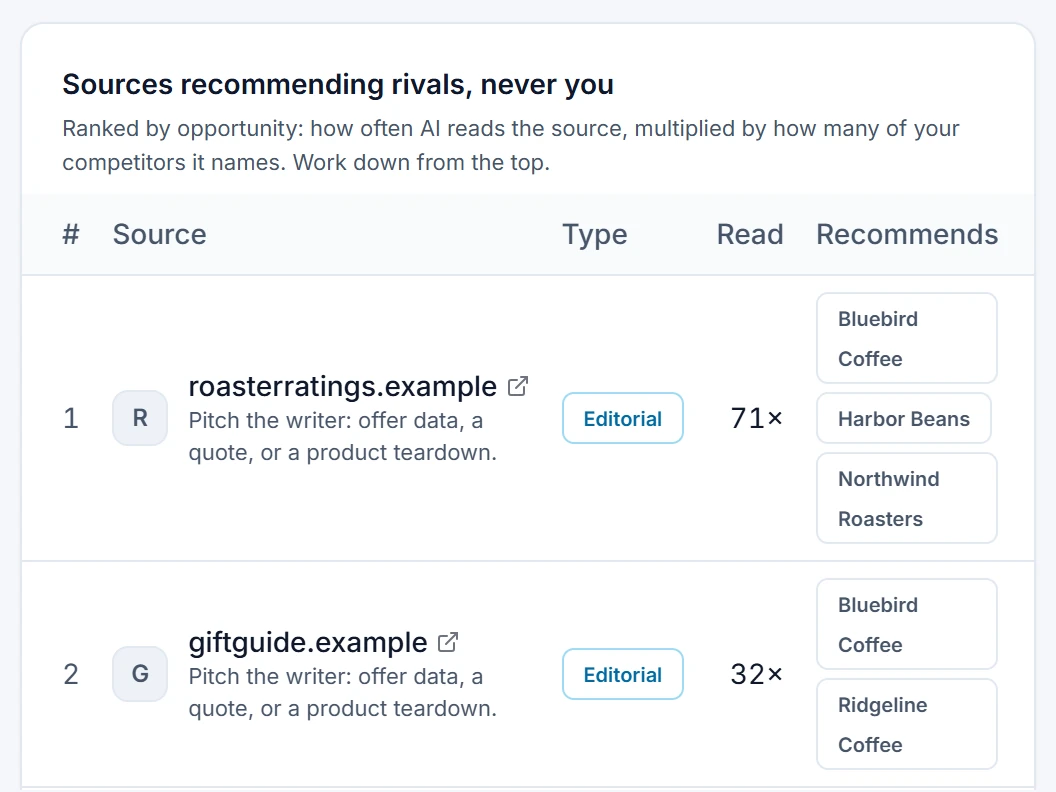
Sources recommending rivals, never you, in a demo workspace: each source AI reads, how often it is read, and which competitors it recommends

One thing to do this week

Not a list of everything wrong: the one listing or page to go after, from the sites the engines read. Plans a marketer can expense without procurement, and a 14-day free trial with every Pro feature except Google AI Mode, no credit card required. Cancel anytime.
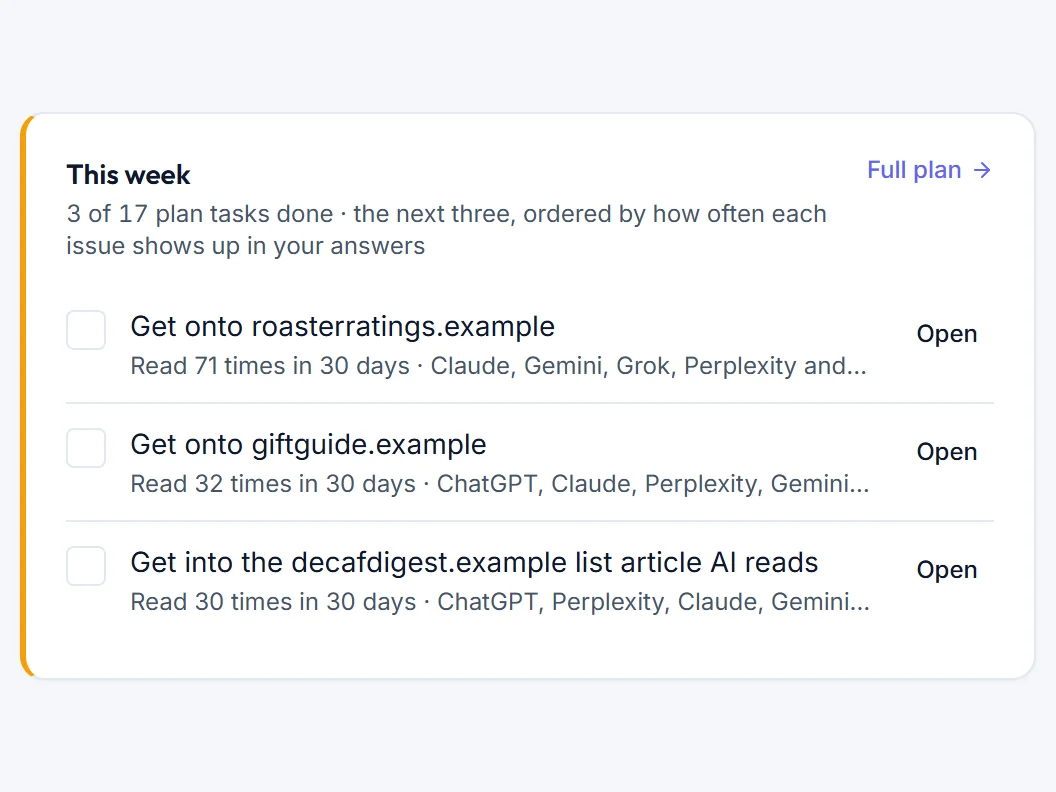
This week in a demo workspace: 3 of 17 plan tasks done and the next three to do

What each plan reads for you every week

Checking by hand means opening each engine, asking each question with web search on, reading the answer and noting who was named. Call it three minutes an answer. Here is what each plan does for you every week.

Starter · $39/mo
125 answers a week

25 questions across 5 engines, plus daily reads on your 3 pinned questions. About 6 hours of manual checking a week — and it tells you the one fix that matters, with the sources the engines read.

Pro · $99/mo
450 answers a week

75 questions across 6 engines including Google AI Mode, over 3 websites, plus daily reads on 10 pinned questions. More than 22 hours a week, with Slack alerts only when a change clears the noise.

Agency · $249/mo
1,500 answers a week

250 questions across 6 engines over 10 client sites, plus daily on 25 pinned. Roughly 75 hours a week of reading, delivered as white-label reports your clients open themselves.

How many answers would you read by hand?

Questions × engines × runs a month. Hours saved assume three minutes per answer.

Pinned-question daily checks come on top: 3 questions on Starter, 10 on Pro, 25 on Agency. See every limit on the pricing page.

Answers a month
500
read, scored and stored
Hours saved
25
at 3 minutes each
Working days
3.1
of 8 hours
Nearest plan
Starter
$39/mo · 25 questions
Example scenario · Starter

A one-product SaaS finds the three questions it loses

25 buyer questions are built from Search Console queries and checked weekly across five engines. The dashboard separates being cited from being named, so the team sees that engines read their docs and still recommend a rival.

Outcome: three questions where competitors are named instead, the roundup pages those engines cite, and a ranked improvement plan — in the first week.

Example scenario · Pro

An in-house team watches a launch day by day

Ten launch questions are pinned for daily checks across six engines including Google AI Mode. A Slack alert fires only when a score moves outside the range to expect between two checks, and the site’s hygiene files (llms.txt, crawler rules, structured data snippets) arrive as a Git pull request whose full diff they see first.

Outcome: the team knows which engine picked up the launch page first and which source it cited, with the hygiene files reviewed in their own repo.

Example scenario · Agency

An agency turns ten client sites into one monthly deliverable

Ten sites, 25 questions each, checked weekly across six engines. Each client gets a read-only share link and a white-label PDF on a schedule, with the rival AI named instead of them on the first page.

Outcome: 1,500 AI answers a week read and scored, one report per client in the agency's branding, no analyst hours copying answers into decks.

Example scenarios describing what the product does on each plan — not customer testimonials.

What you get on day one

5 AI engines on day one ChatGPT, Gemini, Claude, Perplexity, Grok; Google AI Mode from Pro
5 min To your first answers Add your website; we suggest the questions and run the checks
15 Integrations WordPress, Shopify, GitHub, Slack, Zapier and more
$0 To get started 14-day free trial, no credit card

Questions people ask before they start

The questions we get asked most. Every one of these — and 19 more on billing, privacy, scoring and the optimization tools — is answered in full on our complete FAQ.

Answer Engine Optimization (AEO) is the practice of optimizing your website content so that AI-powered search engines — like ChatGPT, Google Gemini, Claude, Perplexity, and Grok — can find, understand, and cite your content in their generated answers. Unlike traditional SEO which focuses on ranking in link-based results, AEO ensures your brand appears when users ask AI assistants questions about your industry.
AEOTrack (aeotrack.io) queries ChatGPT, Gemini, Claude, Perplexity, and Grok with keywords relevant to your business, then reports whether your brand, content, or URLs appear in the responses. You get an AI visibility score, citation counts per engine, and a plan ordered by how often each issue shows up in your answers.
We track the five major AI answer engines: OpenAI's ChatGPT, Google's Gemini, Anthropic's Claude, Perplexity AI and xAI's Grok. Each is called through its API with live web search on, in a fresh session with no chat history, memory or sign-in. Your own chat is personalised and varies from ask to ask, so it can answer differently; the methodology page explains why. Google AI Mode is available as a sixth engine from Pro, and as a $15/month add-on on Starter. We add new engines as they gain market share.
No. AEOTrack is built for marketers, content creators, and business owners. Paste your website URL for a free AEO audit; the action plan gives plain-language recommendations. The FAQ Schema Generator and other tools produce copy-paste-ready outputs.
Traditional SEO tools focus on Google's link-based results — rankings, backlinks, keywords. AEOTrack focuses on AI-generated answers (ChatGPT, Gemini, Claude, Perplexity, Grok), which capture a growing share of search. We measure whether AI engines cite your content and help you optimize for machine comprehension and citation — not just classic SEO.
There's a 14-day free trial with every Pro feature except Google AI Mode unlocked and no credit card required. It runs at Pro capacity for all 14 days (3 websites, 75 tracked questions, 25 GEO topics, 10 competitors, daily checks on 10 pinned questions and 15 on-demand re-checks); adding a card extends it by 14 more days. There's no permanent free tier: real checks mean real queries against paid AI APIs, one live answer per engine per question, with web search on. The free AEO audit asks for your website and work email and shows the result in about a minute, without an account.
It depends on what you need. Judge any tracker on which engines it asks, whether it asks with live web search on, whether it separates being cited from being named, how often it checks and what each answer costs. AEOTrack asks ChatGPT, Gemini, Claude, Perplexity and Grok with live web search on, every week, from $39 a month, and is built around agencies with white-label reports. Some rivals check daily or sell to enterprises; the comparison page lists them with the date each was checked.
Yes. AEOTrack offers a completely free AEO audit at aeotrack.io/audit. Enter your website and work email to get a homepage readiness score, content analysis, schema check and prioritized fixes — plus a real answer from two AI engines showing who they name instead of you — all without creating an account. Results in about a minute.
AEO tracking software monitors whether AI answer engines mention your brand, cite your URLs, or recommend your competitors. AEOTrack queries ChatGPT, Gemini, Claude, Perplexity, and Grok with your keywords, calculates the AI visibility score, GEO overview presence rates and citation counts, and provides a plan ordered by how often each issue shows up in your answers.
An AEO analyzer crawls your webpage and evaluates how well it is optimized for AI answer engines. AEOTrack's analyzer checks content structure, FAQ coverage, schema markup (JSON-LD), readability, keyword targeting, and answer-readiness. It then produces a homepage readiness score from 0-100 with a specific list of what to fix on the page — separate from the AI visibility score, which is read from what the engines actually answered.

See all 46 questions →

See who AI names instead of you

Read the answers for your own questions. 14-day free trial, every Pro feature except Google AI Mode unlocked, no credit card required.